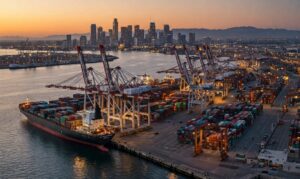
Port of Long Beach
1683 words 6 minute read – Let’s do this!
If the global supply chain feels like it’s throwing curveballs lately… that’s because it is. This week alone, container networks are being reshaped by escalating disruption around the Persian Gulf while energy markets delivered a shock of their own as U.S. diesel prices surged nearly a dollar per gallon in just seven days—one of the largest jumps the trucking industry has ever seen. Vessels are diverting away from key Gulf ports, containers are being discharged at alternate gateways across India and Southeast Asia, and equipment is beginning to get tied up in ways that could ripple back into Asian export markets. At the same time, the sudden spike in fuel costs is quickly moving through trucking, drayage, and intermodal networks, pushing fuel surcharges higher and tightening transportation capacity in pockets across the U.S. In other words, the logistics market may be entering one of those moments where conditions can shift quickly—making it more important than ever for shippers and supply chain teams to stay alert and flexible. In this week’s update, we break down what these developments could mean for ocean freight, inland transportation, and supply chain planning in the weeks ahead. And don’t forget to follow Port X Logistics on LinkedIn for real-time insights—or have our Thursday Market Updates delivered straight to your inbox by reaching out to Marketing@portxlogistics.com.
Container traffic normally bound for ports inside the Persian Gulf is being diverted or discharged early as shipping lines navigate escalating conflict in the region. With several Gulf ports temporarily closing following military strikes on Iran in late February, vessels already en route have been forced to offload cargo at alternative gateways outside the immediate conflict zone. The ripple effects are now showing up at ports surrounding the Gulf, where congestion is building quickly. Facilities such as Khor Fakkan, Sohar, Karachi, and major Indian gateways like Nhava Sheva and Mundra are seeing increased vessel queues as carriers search for the closest safe ports to discharge cargo originally destined for terminals deeper inside the Gulf. Much of the congestion is being driven by containers that had already departed Asian origins before carriers suspended bookings to several Middle Eastern ports. As those vessels approach the region, shipping lines are rerouting cargo toward alternative transshipment hubs such as Singapore, Colombo, or ports along India’s west coast. The closer vessels attempt to move toward the Gulf region, however, the greater the risk of delays due to security restrictions, insurance limitations, and operational uncertainty.
At the same time, cargo that remains inside the Persian Gulf is creating a separate logistical challenge. The region typically imports far more containerized goods than it exports, meaning ships leaving Gulf ports usually reposition large numbers of empty containers back to Asian manufacturing hubs. With vessel movements restricted and terminals intermittently shut down, a significant volume of equipment is now effectively trapped within the region. This could begin tightening container availability in Asian export markets if the disruption continues. The situation is also beginning to influence ocean freight pricing. Rates from Asia into India and parts of the Eastern Mediterranean have climbed sharply since the conflict escalated, and some carriers are applying additional surcharges on cargo moving to or from ports near the conflict zone. In certain cases, emergency charges covering alternative routing and temporary storage are being introduced as carriers attempt to manage cargo flows around the disruption. Beyond the immediate shipping impacts, the instability surrounding the Strait of Hormuz — one of the world’s most important corridors for energy and trade — is adding volatility to global energy markets and transportation costs. Because a significant share of global oil and LNG exports pass through this narrow passage, any prolonged disruption could have far-reaching consequences across shipping, manufacturing, and logistics networks.
While global supply chains today are more resilient than they were during earlier crises, sustained instability in such a critical region would likely continue driving congestion, equipment imbalances, and higher transportation costs across multiple trade lanes in the months ahead.
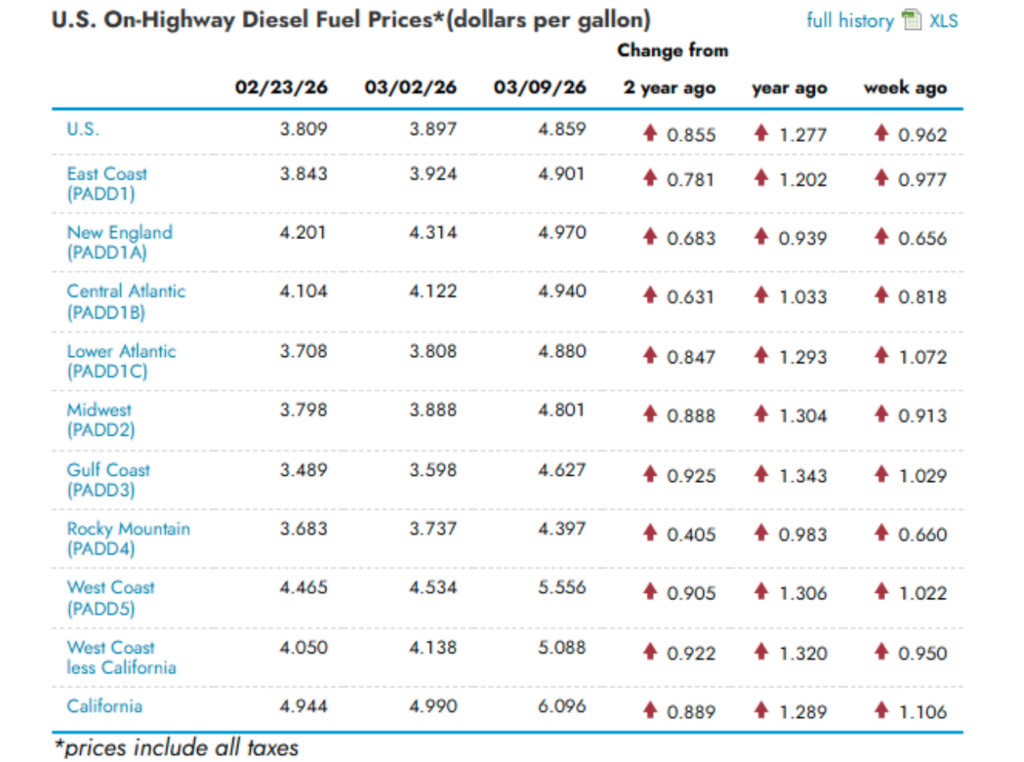
Fuel markets delivered one of the biggest shocks the trucking industry has seen in decades this week, with U.S. diesel prices jumping nearly a dollar per gallon in just seven days. The national average climbed to roughly $4.90 per gallon, according to federal energy data, marking the largest weekly increase since tracking began in the mid-1990s. In some regions, particularly along the West Coast, diesel prices are already pushing above $6 per gallon, dramatically increasing operating costs for trucking fleets. The rapid rise is already moving through the freight market. Fuel surcharges tied to diesel prices have climbed 15–20 cents per mile in many lanes, immediately increasing the cost of long-haul trucking across the country. Because most carrier fuel programs adjust weekly, shippers are likely to begin seeing the impact show up on invoices and brokerage quotes over the coming weeks.
At the same time, the trucking market had already been showing early signs of tightening after nearly four years of depressed freight conditions. Spot rates had begun firming earlier this year following severe winter weather disruptions across the Midwest and East Coast, and the sudden jump in fuel prices is adding new upward pressure to transportation costs.
Capacity dynamics are also beginning to shift. Tender rejection rates — an indicator of carrier willingness to accept contracted freight — have begun climbing again in some markets, suggesting carriers are becoming more selective as operating costs rise. When rejections increase, freight often spills into secondary contract carriers or the spot market, which can drive additional rate volatility.
Another factor contributing to tighter capacity is a gradual reduction in available trucking supply. A wave of smaller carrier exits during the prolonged freight downturn, along with new regulatory scrutiny around driver qualifications and licensing practices, has reduced the overall number of trucks available in some markets.
The combination of rising fuel costs, tightening capacity, and shifting market conditions is beginning to force conversations around freight rate adjustments. Many transportation contracts negotiated late last year were priced during a much softer market environment, and carriers are increasingly pushing to revisit those agreements as operating costs climb. For supply chains, the takeaway is clear: fuel prices can move freight markets very quickly. When diesel spikes this rapidly, the cost increases ripple through the transportation network — from truckload and drayage to intermodal and distribution — often within weeks.
With geopolitical uncertainty continuing to influence global energy markets, fuel prices will remain one of the most important indicators to watch as the transportation market moves further into 2026.