Port of Long Beach
1678 words 6 minute read – Let’s do this!
We’re officially down to the wire for TPM 2026 — and Port X will be there!
Stop by our booth at our usual power position on the promenade across from the Hyatt Regency for live demos, good conversations, and a shot at a door prize with a simple business card drop. We still have a few demo and meeting slots open, so if you want to connect while you’re in Long Beach, reach out to Marketing@portxlogistics.com and let’s get it on the calendar. Now for the fun part (or chaos, depending on the day). Trade policy is throwing plot twists, cross-border freight is dealing with curveballs, and supply chains are doing their best to stay nimble. A Supreme Court ruling has reshuffled how tariffs are applied — without exactly making life easier — while new security disruptions in Mexico are adding another layer of complexity to northbound flows. Tariffs may be changing lanes, enforcement is getting creative, and execution teams are adjusting in real time, all while shippers try to keep costs in check and freight moving. We break down what’s changing, what’s still uncertain, and what to watch next. Don’t forget to follow Port X Logistics on LinkedIn for real-time insights, or get our Thursday Market Updates delivered straight to your inbox by reaching out to Marketing@portxlogistics.com.
The recent ruling by the Supreme Court of the United States materially reshapes the U.S. tariff landscape but does little to restore near-term clarity for global trade. While the decision limits the use of emergency powers that supported the administration’s broadest tariff actions, it has effectively shifted trade policy into a new phase—one where alternative legal authorities are being deployed to maintain pressure on imports rather than unwind enforcement. From an operational perspective, the ruling removes one tariff mechanism but leaves several others in play. The administration has already pivoted to Section 122 of the Trade Act of 1974, enabling temporary, across-the-board tariffs, while also advancing potential Section 301 investigations tied to alleged unfair trade practices. The result is not a rollback of tariffs, but a reconfiguration of how they are imposed—subject to legal challenge, regulatory interpretation, and potential congressional involvement as conditions evolve. For shippers, the most immediate challenge is inconsistency. Tariff rates, implementation timelines, and collection practices have shifted repeatedly within short windows. While public announcements suggest firm policy direction, actual collections at the border have not always aligned in real time, complicating landed-cost modeling, compliance workflows, and contract assumptions. In this environment, uncertainty itself has become a material input cost.
The ruling also introduces fresh questions around existing trade agreements that were negotiated under the now-invalidated authority. Several trading partners are seeking clarity on whether previously agreed tariff ceilings remain enforceable or will be superseded by new, uniform measures. In Europe, progress on a pending agreement has paused as lawmakers evaluate how revised U.S. tariffs interact with World Trade Organization rules. Similar ambiguity surrounds agreements with other U.S. allies, increasing risk for sourcing strategies built around preferential tariff treatment. Refunds remain another unresolved issue. The Court did not specify how duties already collected under the invalidated authority should be handled, leaving the process to lower courts, regulators, and potentially Congress. While administrative mechanisms exist to pursue recovery, the process is expected to be slow, documentation-heavy, and uneven. Importers should not assume rapid reimbursement without proactive filing and sustained follow-up.
What this means for shippers:
The trade environment remains dynamic rather than directional. While certain tariff authorities have been narrowed, others are being expanded or repurposed. Policy risk has shifted from whether tariffs exist to how they are implemented, challenged, and enforced over time.
Next steps to consider:
Shippers should revisit landed-cost assumptions that rely on stable, country-specific tariff treatment and stress-test them against uniform or escalating duty scenarios. Close coordination with customs brokers is essential to ensure entries reflect the correct authority, rates, and eligibility for potential refunds. From a broader supply chain perspective, flexibility remains the advantage—shorter contract durations, diversified sourcing, and adaptable routing strategies will be better positioned to absorb continued policy volatility.
While U.S. trade policy continues to evolve, security conditions in Mexico are emerging as an additional operational variable for northbound supply chains. Recent enforcement actions against organized crime have led to short-term instability across parts of western Mexico, creating localized disruptions that are now intersecting with already complex trade planning cycles.
The reported passing of Nemesio Oseguera Cervantes, associated with the Jalisco New Generation Cartel, has triggered retaliatory activity in multiple states. In response, authorities and local conditions have contributed to road blockades and intermittent highway closures along key freight corridors. These disruptions are most pronounced on routes connecting the Port of Manzanillo—a major entry point for containerized imports—into inland manufacturing regions and onward toward the U.S. border. Although primary border crossings such as Laredo and El Paso remain operational, inland congestion and security-driven rerouting have tightened truck availability and increased transit variability. Carriers operating in affected corridors are facing elevated safety considerations, longer lead times, and growing insurance and risk-management scrutiny, particularly for time-sensitive or high-value freight.
From an execution standpoint, logistics teams are adjusting in real time. Contingency routing, modified transit windows, and revised capacity planning are becoming more common as shippers and carriers work to maintain service continuity. Prolonged instability could create downstream impacts for just-in-time supply chains, particularly in automotive, electronics, and other cross-border manufacturing verticals that rely on predictable inland movement from Mexico to the U.S.
What shippers should watch:
As these conditions develop, several factors warrant close attention. Ongoing tariff litigation and potential refund processes in the U.S. may continue to influence landed-cost forecasting. Any changes in customs guidance from U.S. Customs and Border Protection could affect entry strategy and cash-flow timing. At the same time, security dynamics within Mexico—especially along key inland corridors—may influence routing decisions, transit reliability, and freight pricing across the U.S.–Mexico trade lane.
Bottom line:
Supply chain risk is increasingly multi-dimensional. Trade policy uncertainty and geopolitical or security disruptions are now intersecting, reinforcing the need for flexibility in routing, capacity sourcing, and inventory strategy. Shippers with diversified lanes, adaptable transit plans, and strong carrier partnerships will be better positioned to navigate continued volatility across cross-border networks.
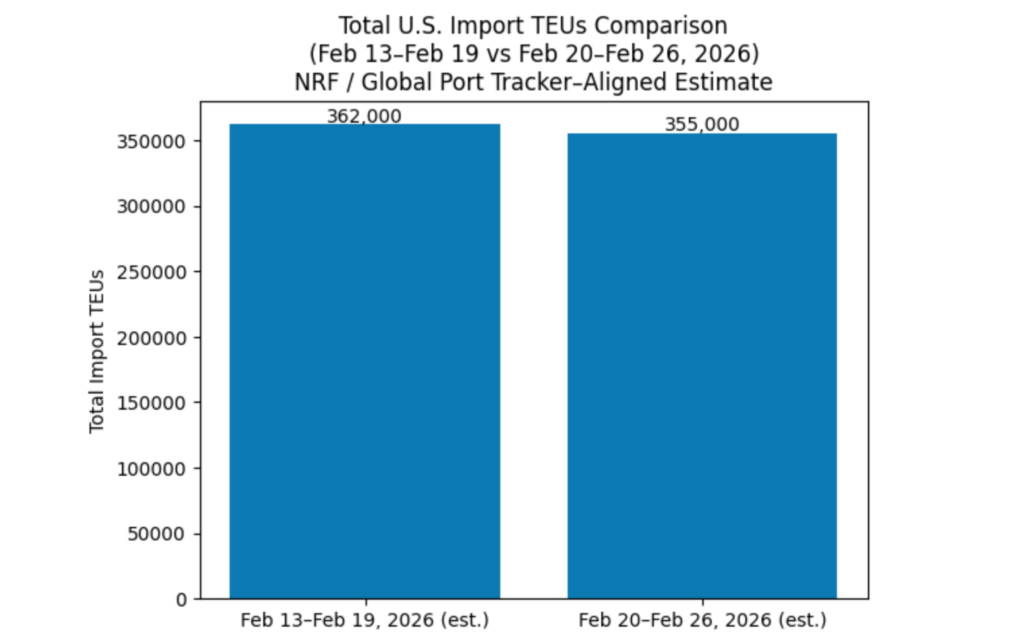
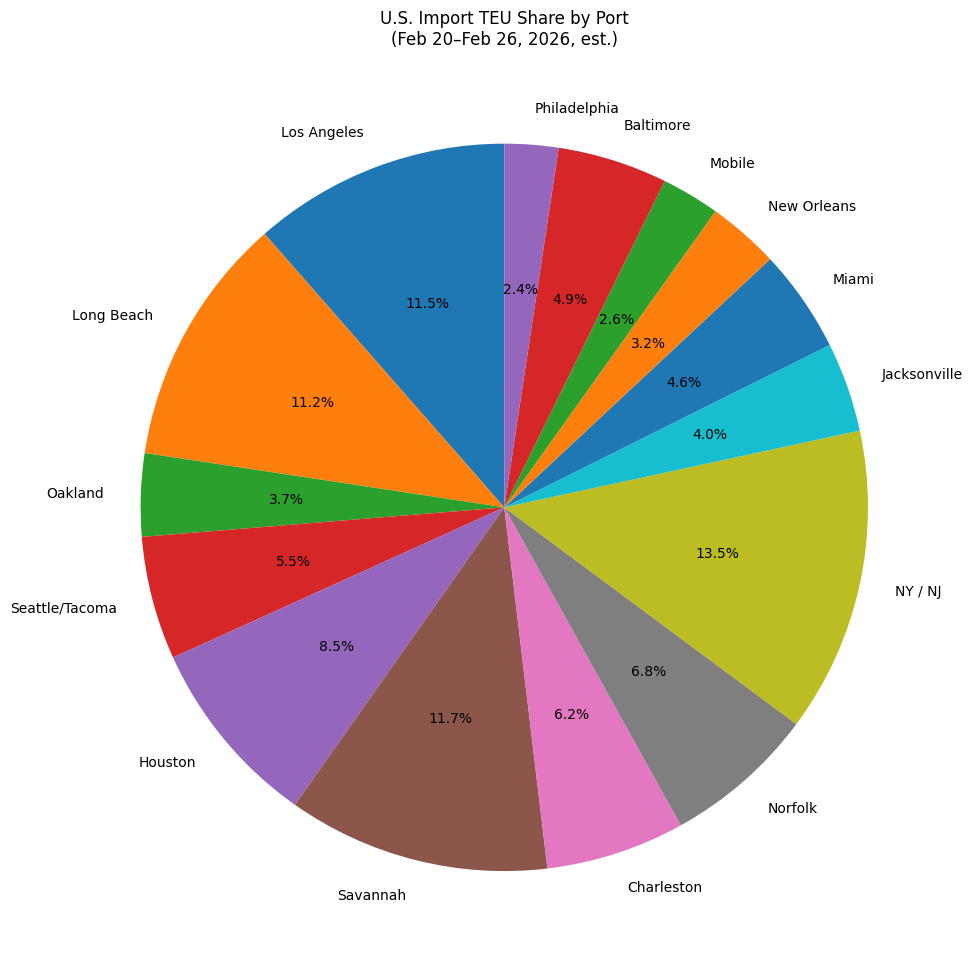
TEU’s are down 1.63% over last week, with majority coming into New York/New Jersey 13.5%, Los Angeles 11.5% and Long Beach 11.2%.