
2186 words 8 minute read - Let’s do this!
October has officially arrived, and apparently the freight market decided a simple change of seasons wasn't dramatic enough. We're heading into China's Golden Week with ocean carriers already pulling capacity, U.S. rail volumes just posted a surprisingly strong week, the Panama Canal finally has some good news after weeks of restrictions, and carriers are taking increasingly serious steps toward returning vessels to the Suez Canal. The common thread this week isn't necessarily more disruption — it's change. Capacity is shifting, routings are changing and some of the pressure points we've been watching all summer are beginning to move in different directions. For shippers, that means October may look very different depending on the lane, mode and routing you're using. Let's get into it. And don’t forget to follow Port X Logistics on LinkedIn for real-time insights—or have our Thursday Market Updates delivered straight to your inbox by reaching out to Marketing@portxlogistics.com.
For the week ending September 26th, U.S. railroads moved 537,397 carloads and intermodal units, up 4.8% from the same week last year. Intermodal was the standout, with 301,610 containers and trailers moving during the week — a 6.3% year-over-year increase. Carload traffic was also positive, increasing 3%. That's an especially interesting turnaround considering that only two weeks earlier, weekly intermodal volume had fallen 4.1% year over year. Zooming out makes the picture even stronger: through the first 38 weeks of 2026, U.S. railroads have handled nearly 10.8 million intermodal units, 4.1% more than at the same point last year. Combined rail traffic is up 3.5%. There is strength underneath the headline number too. Seven of the ten major carload commodity groups increased last week, including chemicals, metallic ores and metals, and nonmetallic minerals. That suggests the increase isn't being driven exclusively by containers moving inland from the ports. For freight buyers, this is worth watching because rail is becoming increasingly important in the transportation-cost conversation. Diesel remains extremely expensive, which improves the relative economics of intermodal on longer inland moves. If strong import volumes continue feeding inland networks while trucking costs remain elevated, intermodal could attract additional freight during the fourth quarter.
What It Means for Shippers
Don't assume rail capacity will remain loose simply because the traditional import peak is winding down. Intermodal volumes are running ahead of last year, and higher truck operating costs could push additional freight toward rail. For longer-haul moves where transit time allows, price truck and intermodal side by side now — before everyone else has the same idea. The winning option isn't necessarily the lowest linehaul rate; it's the best combination of cost, transit, reliability and available capacity.
After weeks of talking about drought, reduced transit availability and increasingly tight operating conditions, improved rainfall and water-conservation measures have allowed the Panama Canal Authority to begin easing some restrictions. The Canal announced this week that it will increase Neopanamax transit availability to 10 vessels per day, bringing total daily Canal capacity to 33 transits beginning October 15. The maximum authorized draft for Neopanamax vessels is also being increased to 49 feet. That's important because the Panama story has been moving in the opposite direction for much of the summer. Reduced rainfall forced Canal officials to tighten daily transit availability, reducing flexibility for container lines and other vessel operators.
More water means more flexibility. An additional transit slot may not sound revolutionary, but container networks operate on incredibly tight schedules. Each additional opportunity to move through the Canal reduces some of the competition for reservations and gives carriers more room to recover schedules when vessels arrive out of sequence. The higher draft allowance matters too. Draft restrictions can force vessels to reduce cargo loads or adjust operations, so additional allowable draft helps carriers use vessel capacity more efficiently. This doesn't mean the Canal's water problem has disappeared. Panama remains highly dependent on freshwater availability, and Canal officials continue to manage water carefully. But after spending weeks watching operating conditions tighten, seeing capacity move in the other direction is an encouraging development.
What It Means for Shippers
Asia-to-U.S. East and Gulf Coast services using Panama should gain a little more operational breathing room. Don't expect transit times or freight rates to suddenly collapse because one additional daily slot became available, but improving Canal conditions reduce one important source of uncertainty heading into Q4. Continue confirming routings and watching carrier advisories — but for the first time in a while, Panama is giving the supply chain a little cushion instead of taking it away.
China's Golden Week has officially arrived — and ocean carriers are already reaching for one of their favorite tools: the blank sailing. The combination of China's Mid-Autumn Festival from September 25–27 and Golden Week from October 1–7 effectively creates an extended factory slowdown across a significant portion of China's manufacturing base. Carriers know export demand normally falls after the holiday, so they're adjusting vessel capacity accordingly. Drewry currently expects 58 blank sailings across the major East-West trades between September 28 and November 1, representing roughly 8% of scheduled sailings. Here's the part U.S. importers should notice: approximately 64% of those cancellations are concentrated on the eastbound trans-Pacific. MSC, for example, announced additional Golden Week adjustments to its Asia–U.S. East Coast network this week, while arranging alternative services for affected bookings. This comes immediately after carriers deployed significant capacity through September. The market can therefore shift surprisingly quickly from plenty of available sailings to fewer departure options. And there's another complication. Chinese ports have spent recent weeks recovering from repeated typhoons that disrupted Shanghai, Ningbo, Yantian and other gateways. Recent estimates put roughly 1.1 million TEUs of vessel capacity at anchorage across those three gateways during the disruption. So Golden Week isn't occurring against a perfectly clean schedule. Some carriers are entering the holiday period while still working through vessel rotations altered by earlier weather delays.
What It Means for Shippers
October's capacity picture may be tighter than October's demand picture. That's an important distinction. Cargo demand can soften while available vessel space tightens simultaneously if carriers remove enough sailings. If you have Asia-origin freight moving during the next several weeks, don't assume weaker post-holiday demand guarantees abundant space or lower rates. Confirm the actual sailing, not simply the published weekly service, and give critical shipments additional flexibility. Blank sailings have a wonderful habit of making a perfectly good logistics plan suddenly require another logistics plan.
Ocean carriers are accelerating preparations to move additional services back through the Suez Canal. This isn't entirely new — we've been watching limited carrier returns for several weeks — but the scale is changing. October is expected to bring additional Asia–North Europe services back through Suez, while other carriers are evaluating or implementing similar changes. MSC has already been partially restoring Suez transits on selected services, while maintaining Cape of Good Hope routing on others. Why does that matter so much? Because sailing around Africa isn't just a longer route. It absorbs vessels. When ships spend additional days traveling around the Cape of Good Hope, those vessels remain tied up longer completing each round trip. That effectively removes capacity from the global fleet even though the ships themselves haven't disappeared. A broader return to Suez reverses some of that effect. Shorter voyages allow vessels to complete rotations faster, potentially releasing effective capacity back into the market. Carriers can then redeploy ships, adjust schedules or potentially remove excess capacity elsewhere. And that could eventually matter for freight rates. The timing is especially interesting because ocean pricing is already moving differently depending on the trade. Freightos reported this week that Asia–U.S. West Coast rates increased another 4%, while Asia–U.S. East Coast pricing remained flat. Asia–North Europe rates, meanwhile, fell 9%, and Asia–Mediterranean rates dropped 7%. In other words, there isn't really one global ocean freight market right now. There are several very different markets happening simultaneously. The big caution remains security. A return to Suez is not the same thing as an “all clear” in the Red Sea. Carriers continue making routing decisions service by service and voyage by voyage, and contingency plans remain in place if security conditions deteriorate.
What It Means for Shippers
Start watching Suez not only as a security story, but as a capacity story. If more vessels return to the shorter route, the global container fleet effectively becomes more productive. Over time, that could create additional vessel availability and put downward pressure on rates in markets where demand doesn't absorb the extra capacity. For cargo moving between Asia, Europe, India and the U.S., don't assume last month's routing is still this month's routing. Ask which route the service is actually using and compare the current transit time with what was quoted originally.
One last number worth watching as October begins: diesel finally moved down. The national average on-highway diesel price fell 14.7 cents this week to $6.382 per gallon, breaking a brutal run of increases that had pushed the national average to $6.529 the week before. Unfortunately, we're not exactly back in bargain territory — diesel remains roughly $2.63 per gallon higher than one year ago. So we're calling this progress, not relief. And that may be the best description of the freight market entering October.
What It Means for Shippers
Don't wait for the market to become universally “good” or “bad” before making decisions, because right now it is neither. It's increasingly lane-specific and mode-specific. The smartest opportunities may come from recognizing where conditions are improving before the rest of the market adjusts.
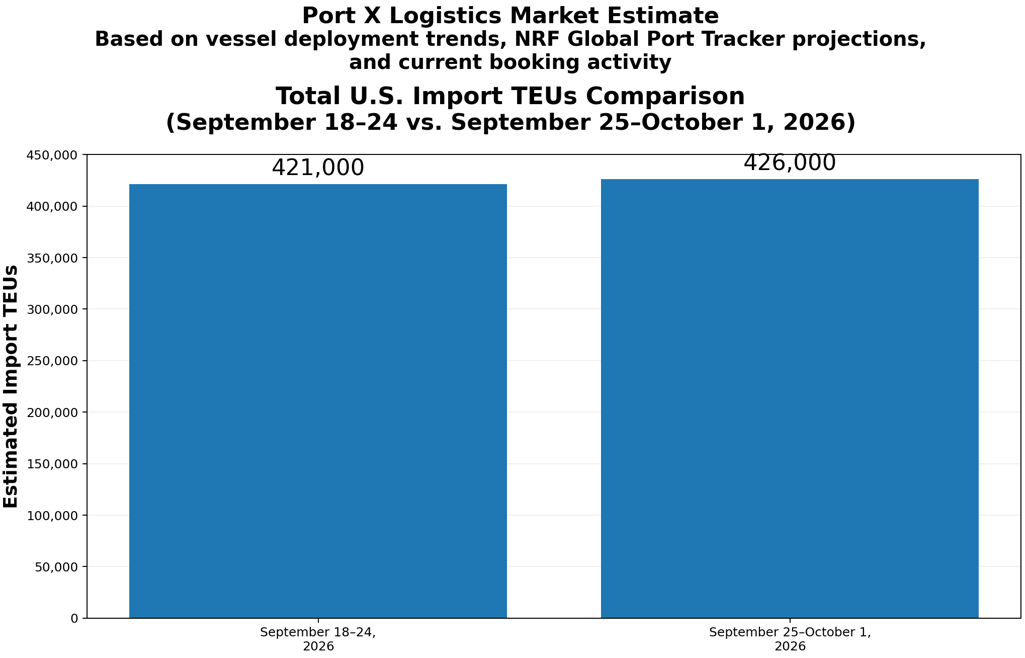
TEU volumes went up 1.18% over last week, with majority coming into New York/New Jersey 15.7%, Los Angeles 18.2% and Long Beach 14.9%
What’s happening at the ports and rails?: LA/LGB: There is a newly proposed three-year incentive program at the LA/LB port complex designed to accelerate adoption of zero-emission drayage trucks. Under the draft guidelines, qualifying zero-emission trucks could receive $60 for every terminal visit, with incentives capped at $36,000 per truck annually. That sounds like an environmental story at first, but I actually think the freight angle is better. Drayage fleets have historically faced a difficult equation with zero-emission equipment: significantly higher truck costs, charging or hydrogen infrastructure requirements, range considerations and the fact that port trucks need to generate enough productive turns every day to make the economics work. A per-terminal-move incentive changes that equation because it rewards the trucks actually doing the work rather than simply subsidizing the initial equipment purchase. And at $60 a move, it isn't insignificant. A truck making 500 qualifying terminal visits in a year would generate $30,000 in incentives. Hit the program maximum and you're talking $36,000 annually toward offsetting the operating economics of that truck. This also comes while LA/LB is handling enormous cargo volumes. Los Angeles just completed the busiest three-month stretch in its history, moving more than 2.9 million TEUs from June through August. August alone reached 955,907 TEUs, and September was expected to remain strong. So the real story becomes: how does the country's largest container gateway modernize the drayage fleet without compromising the enormous amount of freight that fleet needs to move?
What It Means for Shippers
The immediate impact on freight rates or capacity should be limited because this is still a proposed program, but the longer-term implications are worth watching. If incentives make zero-emission trucks more economically viable for drayage carriers, LA/LB could accelerate fleet replacement without forcing the entire cost onto individual truck operators or customers. For shippers, the bigger question will be whether charging infrastructure, truck availability and operating range can grow quickly enough to support the transition without reducing usable drayage capacity. At a gateway moving close to a million TEUs in a month, reliability still has to come first.
When freight hits LA/LB, getting off the vessel is only half the battle. Port X helps take the friction out of what happens next with the flexibility, visibility and capacity to keep containers moving. Competitive transload rates, secure yard access, flexible storage and real-time OpenTrack visibility give shippers more control from terminal pickup through final delivery — backed by our No Demurrage Guarantee with 72-hour dispatch. Changing gate hours? Tight appointments? Last-minute curveball? We adjust and keep rolling. Less waiting, less scrambling and a whole lot less terminal drama. Have West Coast freight that needs a smoother game plan? Send it our way at letsgetrolling@portxlogistics.com.

Did You Know? Chicago is where freight comes to MOVE — and Port X has the muscle to make it happen. With 88 trucks, 150+ chassis and 100+ heavy-haul units ready to roll, our Chicago operation is built to handle everything from everyday drayage and quick-turn imports to overweight, oversized and “how exactly are we moving THAT?” freight. Our experienced team has the equipment, permits and know-how to keep even the challenging stuff moving through one of the country’s busiest inland freight hubs. And when coastal volumes start flowing inland and capacity gets tight, having the right equipment already in place can make all the difference. Big box, heavy box, complicated move or just need it gone yesterday? Chicago has the horsepower — and we’ve got room to roll more. Put our fleet to work at letsgetrolling@portxlogistics.com.